Disclaimer: This page may contain affiliate links. We may earn a small commission for purchases made through links in this post, at no extra cost to you.
TN or Trigeminal Neuralgia
TN or trigeminal neuralgia is a nerve disorder that about 4% of MSers. It is not necessarily a symptom of MS, but a large amount of people with multiple sclerosis are unfortunate enough to suffer from this painful condition. This may be caused by damage from MS to the trigeminal nerve.
It is said to be one of the most painful conditions known, characterized by intense episodes of pain in the face. The symptoms usually begin after the age of 50, but can also occur in the very young, and it is more common in women than men.
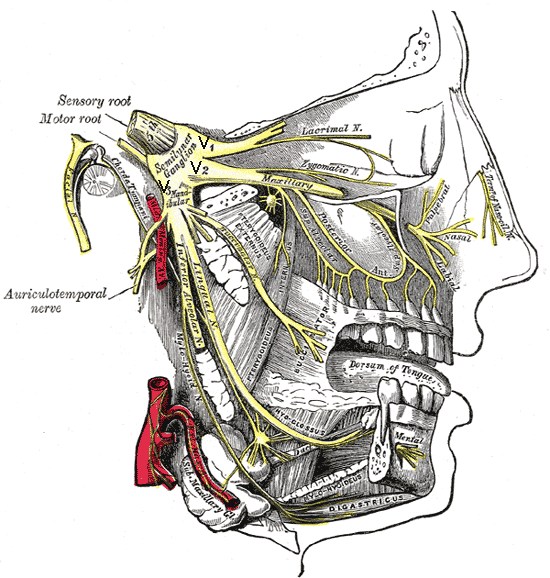
What exactly is the trigeminal nerve? First of all, it is referred to as the fifth cranial nerve, the fifth nerve, CNV, or CN5. Tri- means three, -geminus means twin or thrice (three times twinned) comes from the fact that each nerve, one on each side of the pons, has three major branches. It is the largest of the cranial nerves. Three major branches are – the opthalmic nerve (V1), the maxillary nerve (V2), and the mandibular nerve or V3.
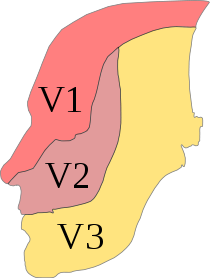
The opthalmic and the maxillary nerves are only sensory. The mandibular nerve has sensory and motor functions like biting, chewing, and swallowing. The sensations you feel in your face stem from this nerve. When you suffer from TN, one, two, or all three, nerves may be affected. You may feel pain in the ear, eye, lips, nose, scalp, forehead, cheeks, teeth, or jaw and side of the face. In about 12% of people with TN, pain can be felt on both sides of the face.
TN - what happens?
What actually happens with trigeminal neuralgia? Episodes of pain can be triggered by something or start for no apparent reason and last for seconds, minutes, or even hours. A trigger can be anything – a touch, like eating, shaving, or brushing your teeth. Sometimes even an air current can starts the episode. Unfortunately, pain can start without any stimulation – it just happens.
Once started, things like wind, very high pitched sounds, talking, or chewing, can cause the pain to be worse. Stabbing, electric shocks, burning, exploding, or a shooting pain, are some of the ways the pain is described. Most times the pain only happens on one side of the face and can last for a few seconds, or minutes, to hundreds of times in one day.
The pain usually occurs in cycles and then remissions that can last months and sometimes years. Pains can start out in one part of the face and spread to the other parts of the face over a period of years. The severity of the pains can also increase as time goes by. One unusual finding, is that people with TN hardly ever a awakened by pain because of episodes while they are sleeping. Sometimes for a short period after waking up, no pain will be felt as well.
Variant of trigeminal neuralgia
A variant of TN is called atypical trigeminal neuralgia, or trigeminal neuralgia, type 2. With this type, the pain is an ongoing, relentless pain that doesn't come and go. It is described as being “a combination of shock-like sensations, migraine-like pain and burning or prickling pain”.
The causes can be damage to the trigeminal nerve as might happen with multiple sclerosis. An aneurysm, a tumor, a traumatic event such as a car accident, or even something like a tongue piercing, among other causes.
Can it be managed, and if so, how? In order for TN to be managed effectively, it first needs to be diagnosed properly and early enough. Many times it is misdiagnosed as temporomandibular joint disorder. The earlier this condition is diagnosed, the less damage to neural pathways will occur.
Treatment for trigeminal neuralgia
Once diagnosed, the first medications are usually anticonvulsants. Carbamazepine is normally tried first, followed by baclofen, lamotrigine, oxcarbazepine, phenytoin, gabapentin, sodium valproate, and possibly clonazepam and lidocaine as well.
Low doses of anti-depressants are may sometimes be used but not often for the neuropathic pain. Opiates like morphine and oxycodone are also sometimes prescribed along with gabapentin to treat nerve pain.
Surgery is only recommended in cases where medication does not work. There are risks to be considered when surgery is the option. Numbness for one. And over time the effectiveness of certain surgical procedures is reduced. The longest relief seems to come when microvascular decompression is done. A few other procedures like balloon compression may help and it is also more effective for some. This procedure is also a good choice for those who have opthalmic nerve pain or have pain after having a microvascular decompression.
Another treatment, glycerol injections work by injecting an alcohol-like substance into the cavern that bathes the nerve near its junction. The liquid corrodes the nerve fibers just enough to mildly injure them. This stops some of the pain signals from getting through.
Another treatment that seems to work well is called radiofrequency rhizotomy. The surgeon takes an electrode to heat the specific area or areas of the affected nerve. The exact region where the pain is triggered is targeted and disabled. Very little numbness results when this procedure is used.
Hope for MSers and people with trigeminal neuralgia
So if you suffer with trigeminal neuralgia along with MS, there is hope. I noticed how several of the medical treatments are similar to those used for multiple sclerosis – gabapentin and baclofen to name a couple. The fact that there are treatments that are effective is a very positive thing. How this translates to specific cases and TN sufferers is yet to be seen. Hopefully this condition, as well as MS, will become disorders of the past.
Here's a website - TNA Facial Pain Association - where you can find out more about this condition if you have more questions.
Go back to MS and Other Conditions.

Dear Friends,
"Life in Spite of MS is a participant in the Amazon Services LLC Associates Program, an affiliate advertising program designed to provide a means for sites to earn advertising fees by advertising and linking to Amazon.com. We're also part of the Ebay Partner Network, another affiliate program."
We'd also like you to know it doesn't cost one cent more when you click through the links here on our blog. Not one single penny. And we will make a little extra cash when you do click through. We'll be ever so appreciative. You also have our word that we'll only link to things that we would use ourselves, (or wish we could have or use).
Sincerely,
Cir & Akrista
You are reading original content written by Akrista or Cir L'Bert of Life in Spite of MS. If you enjoyed reading this blog, please consider following us on Facebook, Twitter, Pinterest, and Instagram. See you there!
Privacy Policy ~ Advertising Policy ~ Disclaimer ~ Contact Us ~ About Us


New! Comments
Have your say about what you just read! Leave me a comment in the box below.