Disclaimer: This page may contain affiliate links. We may earn a small commission for purchases made through links in this post, at no extra cost to you.
Demyelination
What is demyelination?
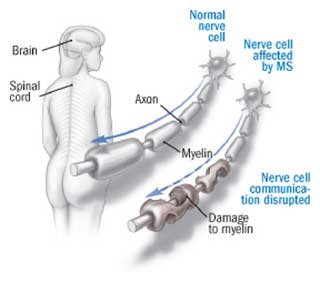
According to the dictionary, demyelination means a "loss of myelin from the nerve sheaths, as in multiple sclerosis." So what is myelin? And what are nerve sheaths?
Myelin is the soft, white, fatty material produced by glial cells called oligodendrocytes in the central nervous system or CNS. It is made up of about 80% lipid fats and about 20% proteins.
Click here to read one woman's journey of MS.
The myelin sheath insulates the the nerve fibers or axons. Nerve impulses travel along the nervous system to and from the brain. The myelin helps the nerve impulses travel smoothly and quickly from one nerve to the next.
When damage to the myelin occurs, the nerve impulses can no longer travel smoothly throughout the nervous system. In multiple sclerosis, it occurs in the CNS. The billions of nerves in the brain and spinal cord as well as the optic nerve are affected.
In MS, lesions form along the myelin, which causes symptoms to occur throughout the body. The symptoms can occur anywhere along the central nervous system. The symptoms can be intermittent - meaning they come and go; or are not continuous.
Here's a short video animation that helps to explain what happens.
Ideally the oligodendrocytes produce and maintain myelin. They also repair damaged myelin. Total repair or remyelination can happen after an attack or exacerbation. In this case the symptoms would go away and the MS patient would return to the point they were before the attack.
Each oligodendrocyte produces myelin for several axons. Each axon has several oligodendrocytes producing myelin for it. If the oligodendrocytes are damaged only partial remyelination may occur. If this were to happen, some disability may remain.
The destruction of the myelin is shown by scars or lesions along the axons. It has been found that sometimes even the axons can become damaged or destroyed as well.
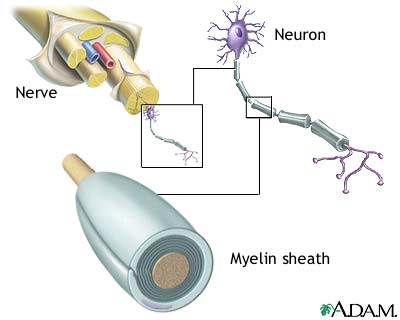
There are glial cells called astrocytes. These are responsible for the scar tissue which forms in place of the myelin. The scars or lesions along the axon cannot perform the way the myelin does. So there will almost always be some type of disability.
There are so many variables in MS, that no one can say for sure:
What will happen.When it will happen.How it will happen.And who it will happen to.
Multiple sclerosis is such a complicated disease.
Go from Demyelination back to What is MS?
Go to Who Gets MS?

Dear Friends,
"Life in Spite of MS is a participant in the Amazon Services LLC Associates Program, an affiliate advertising program designed to provide a means for sites to earn advertising fees by advertising and linking to Amazon.com. We're also part of the Ebay Partner Network, another affiliate program."
We'd also like you to know it doesn't cost one cent more when you click through the links here on our blog. Not one single penny. And we will make a little extra cash when you do click through. We'll be ever so appreciative. You also have our word that we'll only link to things that we would use ourselves, (or wish we could have or use).
Sincerely,
Cir & Akrista
You are reading original content written by Akrista or Cir L'Bert of Life in Spite of MS. If you enjoyed reading this blog, please consider following us on Facebook, Twitter, Pinterest, and Instagram. See you there!
Privacy Policy ~ Advertising Policy ~ Disclaimer ~ Contact Us ~ About Us


New! Comments
Have your say about what you just read! Leave me a comment in the box below.